Cell Counting Application
Our denoising technology enhances fluorescence microscopy images for accurate cell counting and analysis.
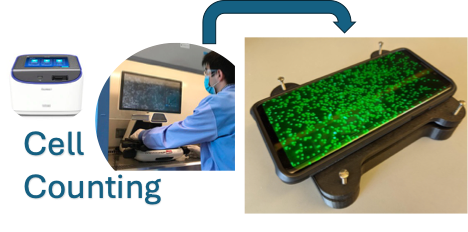
Fluorescence Microscopy Cell Counting
Our technology enhances the quality of fluorescence microscopy images, enabling more accurate cell counting and analysis for research and diagnostic applications.
How It Works
Four steps, from a hazy smartphone capture to a restored image you can measure.
1 · Upload
Send a fluorescence frame as JPG, PNG or TIFF. It is downscaled to 1024 px on the longest side before processing, which keeps memory bounded and response times a few seconds.
2 · Threshold
A 256-bin intensity histogram separates the bright fluorescent particles from the broad low-intensity background of the scattering medium. The resulting mask zeroes the background out.
3 · Restore
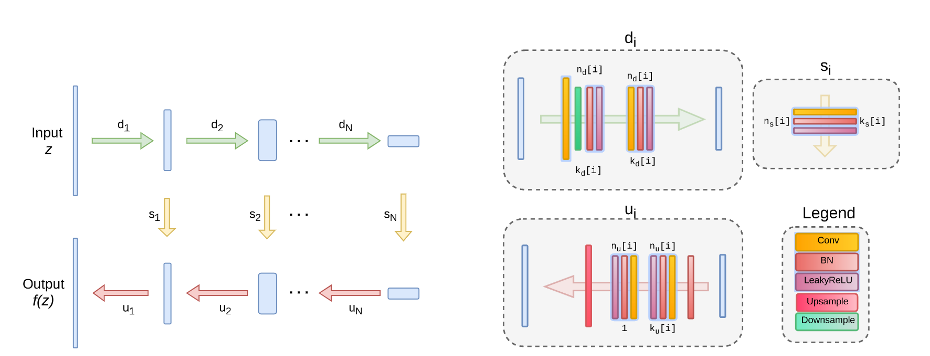
A skip-connected convolutional network reconstructs the masked image from random noise. No training set is involved — the network architecture itself acts as the image prior.
4 · Compare
Drag the slider to see exactly what was removed and what survived. Both frames stay at full resolution so you can check that real particles were preserved, not smoothed away.
How HIST-DIP Works
Smartphone fluorescence microscopy trades optical quality for portability: the sensor is small, the excitation light is uneven, and the biological medium scatters light into a bright haze that buries the signal. HIST-DIP removes that haze in two stages, without a training set of clean reference images.
Histogram Thresholding
Separate signal from background
The image is converted to grayscale and its intensity histogram is computed across 256 bins. In these samples the distribution is strongly bimodal: the scattering medium forms a broad low-intensity bulk, while the fluorescent particles sit in a sparse bright tail.
A threshold placed between those two populations produces a binary mask. Multiplying the original image by that mask keeps the fluorescent signal at its true intensity and drives the background to zero — so the second stage never has to model the haze at all.
Deep Image Prior
Restore structure without training data
A convolutional encoder–decoder with skip connections is fitted to the single masked image. Its input is not the image — it is a fixed tensor of random noise. The network is asked to reproduce the observed image from that noise.
Because a CNN reconstructs smooth, self-similar structure far more readily than it reproduces pixel-independent noise, the clean image emerges early in the fit and noise is only absorbed later. Stopping before that point yields the restoration. The architecture itself is the prior; there are no learned weights from any dataset.
Network & Fitting
Reported Results
Validation across the paper’s image set, before and after HIST-DIP:
Contrast-to-noise and signal-difference-to-noise ratios improved alongside these. PSNR measures reconstruction error against a reference; SSIM measures perceived structural agreement, which is why the near-zero starting value matters — the raw smartphone frames retain almost none of the reference structure.
What this demo runs
Fitting a Deep Image Prior takes 2000 gradient steps per image, which is far too slow for an interactive page. This demo therefore performs a single forward pass through a network whose weights were saved after such a fit, so results appear in seconds. It is a fast approximation of the published pipeline, not the full per-image optimisation — for quantitative work, run the reference implementation from the paper.
H. Govindaraju, M. N. Tahir and U. Hassan, HIST-DIP: histogram thresholding and deep image priors assisted smartphone-based fluorescence microscopy imaging, Analyst, 2025, 150, 3909.
Network Architecture
The restoration network is a five-scale encoder–decoder. Each downsampling stage halves the spatial resolution while widening to 128 channels; each upsampling stage mirrors it with bilinear interpolation and reflection padding.
The thin skip connections — four channels per scale — are deliberately narrow. They carry enough fine detail to keep particle edges sharp, but are too constrained to pass pixel-level noise straight through to the output, which is what makes the architecture act as a denoising prior.